Confirm the source at the property
An active fixture, appliance, supply pipe, service connection, or exterior event may produce similar visible water. The first task is to identify safe shutoff options and obtain qualified plumbing findings.
The Upper Dublin burst pipe service records the observed break area and water route. Fort Washington supplies the location, while current building evidence supplies the cause.
- Report whether active flow has stopped.
- Photograph the source area before repair changes it.
- Avoid wet electrical equipment and unstable ceilings.
- Keep the failed component available for the plumbing professional.
Preserve the original water boundary
Supply water can cross a floor, enter a wall, follow penetrations, and appear on the level below. Contents movement and extraction quickly change the scene, so photographs and a room diagram should come first when safe.
The diagram labels visible water, damp edges, dry references, and any inaccessible zone. It also identifies material types rather than assuming pipe or foundation construction from township history.
- Photograph doorways and floor transitions.
- Mark wall bases beyond the puddle.
- Check ceilings and rooms below the source.
- Record dry portable contents before relocation.
Extraction should follow the connected route
Accessible liquid is recovered with tools matched to the surface. Carpet, hard flooring, seams, and tight perimeters may need different methods. After the first pass, readings show whether the boundary extends beneath a finish or into a partition.
Water extraction in Upper Dublin focuses on liquid removal and the remaining moisture map. A small opening may be considered when a concealed layer cannot be inspected or dried predictably.
- Recover open water before increasing evaporation.
- Protect unaffected routes from tracking.
- Document the material condition at every access point.
- Keep plumbing debris separate from mitigation removal.
Dry materials according to their response
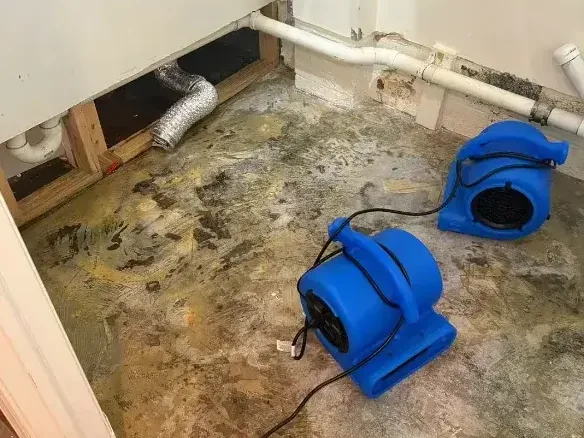
Air movement encourages moisture to leave exposed surfaces, and dehumidification removes that moisture from room air. Placement follows the map and the assembly present.
Repeat measurements at the same labeled points show whether a wall, floor, or ceiling is improving. If one area stalls, the crew checks access, airflow, humidity, and material condition before changing the setup.
- Use comparable settings for repeated readings.
- Track room conditions with material data.
- State why equipment moves.
- Confirm each affected level independently.
Pipe repair and interior recovery
The former township treatment facility stood in a floodplain, and the sewer upgrade moves wastewater toward Ambler through a watertight pump station and force main. For an indoor loss, the owner also needs the plumber's findings and the restoration scope. Keeping these records together makes the repair and drying handoff easier to follow.
Likewise, almost all township drainage reaches Wissahickon Creek, while smaller areas drain toward Neshaminy Creek and Pennypack Creek. Regional drainage cannot replace a property source investigation.
- Record the provider contact and the plumber responsible for source repairs.
- Use property findings for the cause statement.
- Do not infer a flood zone from township drainage.
- Separate sewer context from a sanitary supply loss.
Close with two coordinated records
The plumber record describes the failed component and correction. The mitigation record shows water boundaries, extraction, openings, equipment, and final readings. Keeping them distinct makes the full sequence easier to understand.
The Upper Dublin water damage hub offers source specific pages for ceiling, roof, sewage, and appliance losses. The correct path follows observed evidence rather than the name of a past event.
- Pair source photographs with repair notes.
- List every affected room and material.
- Identify repair needs remaining after drying.
- Do not promise coverage from documentation alone.
Handle interruptions and restored supply cautiously
A public main break can interrupt or alter service conditions, but an individual owner should follow the utility and plumbing professionals for instructions about the public supply. Inside a building, fixtures and appliances should be observed after service conditions normalize, especially if a private leak or repair was already underway.
The mitigation file should avoid claiming that a pressure change caused a component failure unless a qualified investigation supports that conclusion. Timing can be recorded as timing. Photographs, plumber findings, and observed water routes supply the stronger evidence needed for a cause statement.
If water appears again after a shutoff or repair, the new occurrence deserves a separate note. The crew can extend the moisture map, protect new areas, and preserve updated source observations instead of assuming the first explanation still covers everything.
A restored supply may reveal dripping at a fixture or connection that was not visible during interruption. Occupants should avoid making an unsafe repair and should report the new observation to the plumbing professional. The mitigation team can protect nearby finishes and update the affected boundary.
When several events occur close together, separate timestamps and photographs become especially valuable. They help distinguish the original release, the repair, the restoration of service, and any later water observation without forcing them into one unsupported cause.
- Follow official utility instructions for public service conditions.
- Note when water appeared and when the source was stopped.
- Ask the plumber to describe the private component finding.
- Photograph any new water boundary before additional extraction.
- Update affected rooms and material points after a recurrence.